AI Content Creation for Small Business: How to Compete with Big Brands on a Tiny Budget

Here is a frustrating truth that every small business owner knows in their gut. The brands winning online are not always selling the best products. They are selling the best visuals. Scroll through any marketplace or social feed, and it is obvious. Big companies have polished product photos, slick videos, and a steady stream of content that makes their stuff look irresistible. Meanwhile, the one-person shop with a genuinely great product is stuck posting iPhone photos against a wrinkled bedsheet.
That visual gap has been the single biggest disadvantage for small businesses in e-commerce. And until recently, there was no realistic way around it. Professional photography costs hundreds (often thousands) per product. Video production? Even more. Hiring a designer for social content? That is a recurring expense most small budgets simply cannot absorb.
But something has changed. AI content creation tools have gotten remarkably good, remarkably fast. And for the first time, a small business owner with zero design skills and a very modest budget can produce product visuals that genuinely compete with what the big players put out. Let's talk about how.
The Visual Content Gap Is Real, and It Costs You Sales
Before diving into solutions, it is worth understanding just how much this gap matters. Research consistently shows that product image quality is one of the top factors influencing online purchase decisions. Shoppers cannot touch or hold your product. The photos and videos are the entire experience.
Better visuals lead to higher click-through rates on ads, stronger conversion rates on product pages, fewer returns (because customers know exactly what they are getting), and more engagement on social media. One widely cited study found that products with high-quality lifestyle images convert up to 30% better than those with basic white-background shots alone.
Big brands know this. That is why they spend tens of thousands on content production every quarter. They have in-house creative teams, agency partnerships, dedicated photo studios, and content calendars planned months in advance. A small business trying to compete against that with a smartphone and Canva is fighting with one hand tied behind their back.
Or at least, they were.
How AI Levels the Playing Field
The core promise of AI content creation for small business is straightforward. You get access to capabilities that used to require an entire creative team, condensed into software that runs on credits instead of retainers. The quality ceiling has risen dramatically. Today's AI tools can generate product scenes, remove backgrounds, create short videos, and produce social-ready content that looks genuinely professional.
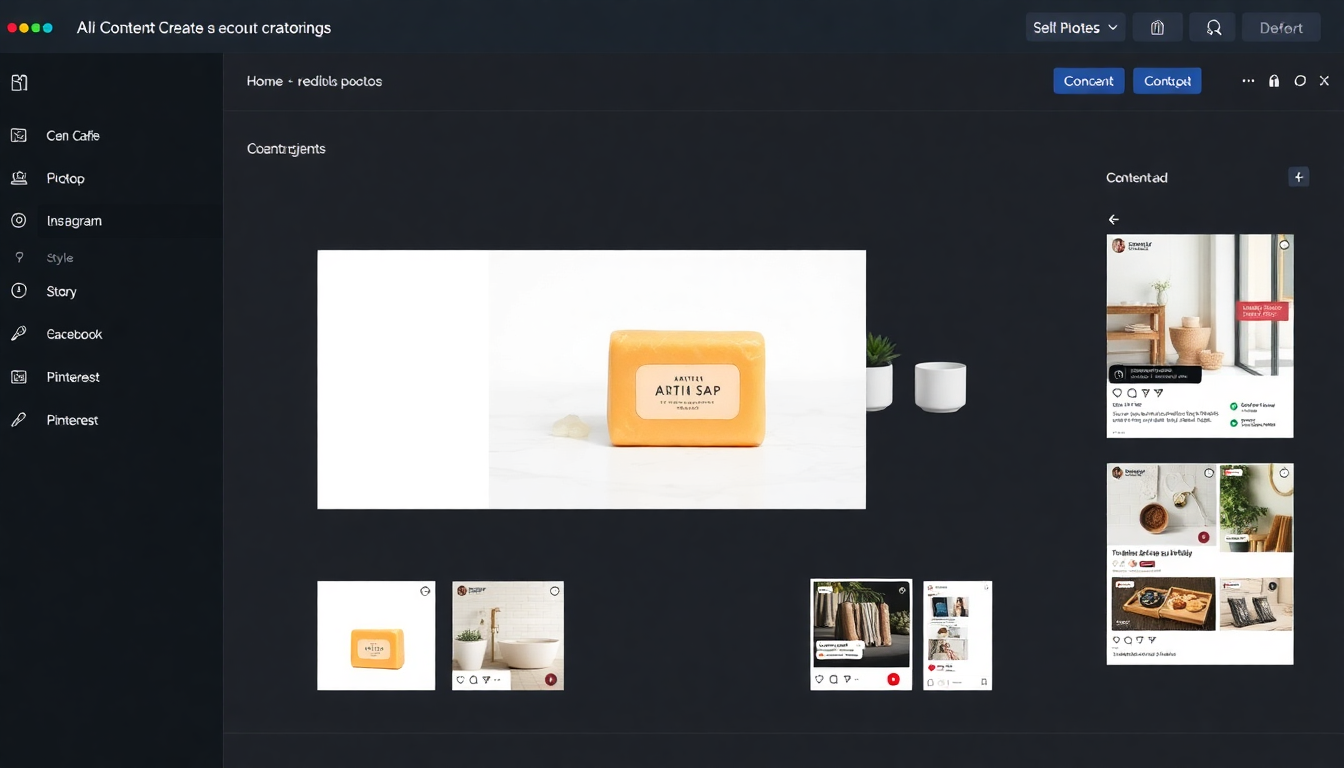
A platform like Pixelus is a good example of what this looks like in practice. It is a full AI creative studio, not just a single trick. You can generate product images from scratch, place your product into realistic scenes, create short videos from still photos, run virtual try-ons for fashion items, and publish content directly to social channels. The whole workflow lives in one place, and it runs on a credits-based pricing model, meaning you pay for what you use rather than committing to an expensive monthly subscription you might not fully utilize.
The important shift here is not just cost. It is speed and independence. You do not need to coordinate with a photographer's schedule. You do not need to ship product samples to a studio. You do not need to wait days for retouched files. You can go from "I need a product photo" to "here is the finished image" in minutes, sitting at your kitchen table.
A Practical Workflow for a One-Person Operation
Let's get specific. If you are running a small business and want to start producing better content with AI tools, here is a realistic workflow that does not require any special equipment or design experience.
Step 1: Capture a Clean Source Photo
Grab your product and take a photo with your phone. Natural light near a window works great. You do not need a fancy background, just make sure the product is well-lit and in focus. If you want more guidance on nailing this step, check out our beginner's guide to product photography.
Step 2: Remove the Background
Upload your photo to an AI tool and let it isolate the product. Modern background removal is incredibly accurate, handling tricky edges like translucent materials, fine hair, and complex shapes. In Pixelus, this happens automatically when you upload.
Step 3: Generate Your Scene
This is where it gets fun. Instead of building a physical set, you describe what you want and AI creates it. Want your candle on a cozy wooden shelf with soft warm lighting? Done. Need your skincare bottle on a marble countertop with morning sunlight? Describe it and the AI renders a realistic environment, then composites your product into it with proper shadows and reflections. You can learn more about this process in our guide to AI product photography.
Step 4: Create Variations
Here is where small businesses gain a real advantage. Since each new scene costs pennies instead of hundreds of dollars, you can create multiple versions of every product image. Different backgrounds for different platforms. Seasonal variations. A/B test candidates. Content that would have taken weeks and thousands of dollars to produce in a traditional setup can be generated in a single afternoon.
Step 5: Extend to Video and Social
Once you have strong product images, AI can take them further. Generate short product videos from your still photos for platforms that prioritize motion content. Create formatted posts for Instagram, TikTok, and Pinterest. Pixelus includes social publishing features, so you can go from product photo to published post without bouncing between five different apps.
The ROI of Better Visuals
Let's talk numbers, because this is where the argument really comes together for small businesses watching every dollar.
A traditional product photography session runs anywhere from $200 to $1,500 per product, depending on your market and the complexity of the shoot. If you need lifestyle shots, styled sets, or multiple angles, that number climbs quickly. Video production starts at several hundred dollars per clip and can easily reach into the thousands.
With AI tools for small business, the cost per finished image drops to a few dollars or less. A credits-based model means you are not paying for a studio's downtime or a photographer's travel. You are paying for the actual output. For a small brand managing 50 to 100 SKUs, the savings over a year can easily reach five figures.
But the real ROI is not just in what you save. It is in what better content earns you. Higher conversion rates on product pages mean more revenue from the same traffic. Better ad creatives mean lower cost per acquisition. Stronger social content means organic reach you did not have to pay for. And fewer returns (because your photos accurately represent the product) means less money lost to reverse logistics.
When you add it all up, investing in better visual content is one of the highest-return moves a small business can make. AI just removed the barrier that used to make that investment impractical.
Building a Content System That Scales
One-off improvements are great, but the real advantage comes from building a system. Big brands have content machines that produce a steady flow of fresh visuals. With AI, you can build your own version of that machine, even as a team of one.
Batch Your Content Creation
Set aside one afternoon per week or per month to produce all your visual content. Photograph new products, generate scenes, create video clips, and queue up social posts. Batching is far more efficient than creating content ad hoc, and AI tools make it possible to produce a week's worth of content in a few hours.
Develop Templates and Consistency
Pick two or three scene styles that match your brand and stick with them across your catalog. Consistency builds trust. When every product in your store has the same visual quality and style, your brand looks established and professional, even if you launched last month.
Repurpose Everything
A single product photo can become a dozen pieces of content. The original lifestyle shot for your product page. A cropped version for your marketplace listing. A video clip for Instagram Reels. A square format for a Facebook ad. A Pinterest pin. AI makes each of these transformations fast and inexpensive. Our guide on creating product content for social media goes deeper on this strategy.
AI Capabilities That Matter Most for Small Business
Not every AI feature is equally useful when you are working with a tight budget and limited time. Here are the capabilities that deliver the most impact for small business product photography and content creation.
- Background removal and scene generation. This is the foundation. Being able to take a basic product photo and place it into a professional-looking environment is the single biggest upgrade most small businesses can make to their visual content.
- Image generation from prompts. Sometimes you need a lifestyle scene, a texture, or a backdrop that does not exist yet. AI image generation lets you create exactly the visual you need without sourcing stock photos or hiring a designer.
- Video from still images. Short product videos dramatically outperform static images on social platforms and in ads. Being able to generate motion content from a single photo removes one of the most expensive and time-consuming content types from your production bottleneck.
- Virtual try-on. If you sell clothing, accessories, or anything that customers want to see "on a person," AI-powered try-on features let you show products on diverse models without organizing a full fashion shoot.
- Social publishing. An often-overlooked time saver. Tools that let you format, caption, and publish directly to social channels from the same interface where you created the content eliminate the friction that causes many small businesses to just not post.
- Credits-based pricing. For small businesses, predictable and flexible costs matter. Pay for what you create rather than committing to a flat monthly fee, and scale up during busy seasons without renegotiating contracts.
Getting Started Without Spending a Dime
If you have been on the fence about trying AI content creation for your small business, here is the simplest possible starting point. Grab a product, take a photo, and run it through an AI creative tool to see what comes out. Most platforms, Pixelus included, offer free credits so you can experiment before spending anything.
Start with one product. Generate a few scene variations. Compare them to what you are currently using on your product pages or social profiles. If the difference is as dramatic as it usually is, you will quickly see the path forward.
The gap between big-brand content and small-business content used to be a function of budget. It does not have to be anymore. The tools exist. They are affordable. They are fast. And they are good enough that your customers will not be able to tell the difference between your AI-generated product shots and the ones from the company that spent $10,000 on a photo shoot.
That is the real story of AI content creation for small business. Not that it is a clever shortcut or a gimmick, but that it is a genuine equalizer. The playing field is not perfectly level yet. But it is closer than it has ever been, and the businesses that figure this out early are the ones that will punch far above their weight.
Ready to see what your products could look like?
Pixelus gives you a full AI creative studio with free credits to start. Upload a product, generate scenes, create videos, and publish to social, all in one place.
Try Pixelus Free